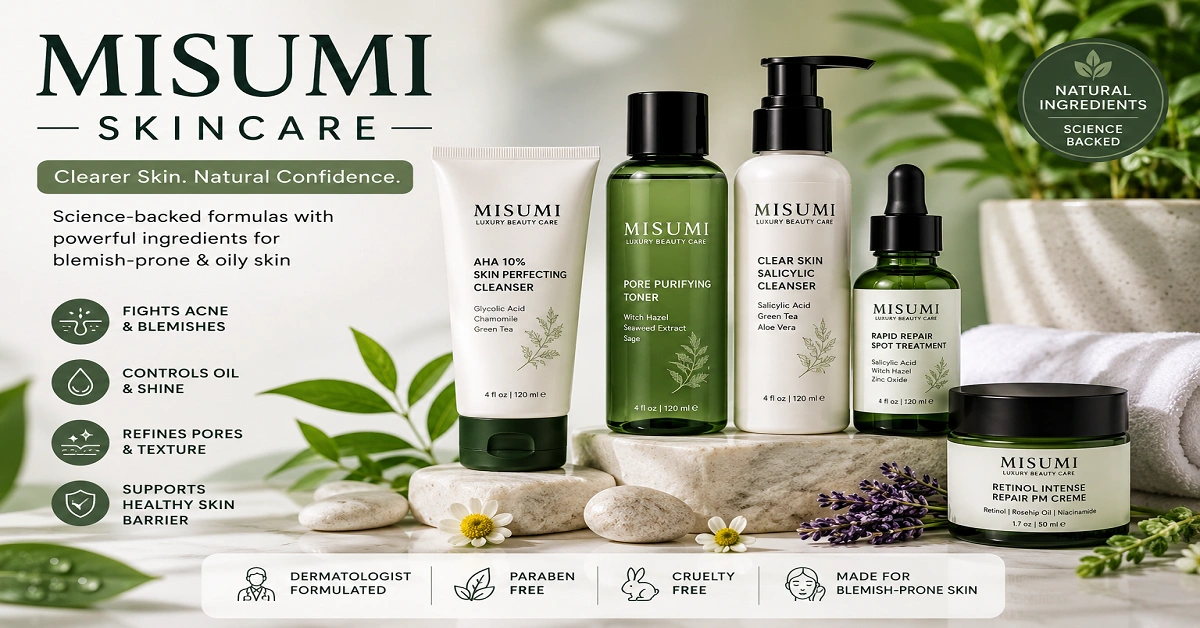
If you have been searching for Misumi online and found yourself wondering whether it is a skincare brand, you are not alone. The name “Misumi” is used by different businesses, but one of the most relevant results for skincare is Misumi Luxury Beauty Care, a brand that focuses heavily on blemish-prone and oily skin. Its product range has included cleansers, toners, moisturizers, spot treatments, body washes, retinol products, and skincare kits designed around acne and skin clarity. The brand says its formulas combine natural ingredients with cosmetic chemistry and that its skincare experts and dermatologists have more than 25 years of experience.
Misumi’s approach is particularly interesting because it does not position itself as a general beauty brand covering every possible skincare concern equally. Instead, its website emphasizes blemish-prone, oily, and acne-prone skin, while also discussing concerns such as premature aging, clogged pores, redness, and uneven-looking skin. Its ingredient philosophy includes botanical ingredients such as lavender, chamomile, rosehip seed oil, sage, witch hazel, licorice root, seaweed extract, lemon, and sunflower seed oil.
There is also an important current consideration for anyone researching Misumi products. The official Misumi site currently lists several products as sold out, including its Clear Skin Duo Set, Blemish Clear Body Wash, Clear Skin Salicylic Cleanser, Pore Purifying Toner, and Rapid Repair Spot Treatment. Independent online discussions from late 2025 and 2026 have also reported that the brand was discontinuing products, although the official website remains available. Because availability can change, shoppers should verify the current status directly before planning a routine around a specific Misumi product.
What Is Misumi Skincare?
Misumi Skincare is a beauty brand associated with skincare products designed primarily for people dealing with blemishes, oily skin, clogged pores, and acne-related concerns. The official website presents the brand as a premium skincare company dedicated to developing solutions for blemish-prone skin. It also describes its products as being made with natural ingredients and developed with input from skincare professionals and dermatologists.
The brand’s product philosophy revolves around creating a relatively focused routine instead of encouraging consumers to purchase dozens of unrelated products. For example, Misumi has offered a Complete Clear 3-Step System built around an AHA 10% Skin Perfecting Cleanser, Pore Purifying Toner, and Retinol Intense Repair PM Creme. The idea is easy to understand: cleanse the skin, use a targeted treatment step, and support nighttime skin renewal.
For consumers, this kind of structure can be appealing because skincare can quickly become confusing. One person may use a cleanser, exfoliant, toner, serum, moisturizer, oil, mask, and several treatments without really knowing which product is doing what. Misumi’s acne-focused approach attempts to make the routine more purposeful.
The Story and Philosophy Behind Misumi
Misumi’s philosophy is based on combining natural ingredients and skincare science. According to the brand, its team has spent more than 25 years researching and testing natural ingredients, with the goal of supporting the skin’s natural processes. Its ingredient library includes botanical extracts and oils alongside active skincare ingredients used for exfoliation and blemish care.
That combination reflects a broader trend in modern skincare. Consumers increasingly want products that feel gentle and plant-inspired but still contain recognizable active ingredients. The challenge is finding the right balance. Natural does not automatically mean gentle, and synthetic does not automatically mean harmful. What matters is the complete formula, concentration, formulation quality, intended use, and how a particular person’s skin responds.
Misumi’s website also highlights an anti-aging focus, saying that its products are intended to help protect healthy-looking skin, prevent damage, and address signs associated with premature aging. This gives the brand a wider purpose than acne care alone.
Who Is Misumi Skincare Designed For?
Misumi is particularly aimed at people with oily and blemish-prone skin. Its official “Why Misumi?” page describes the brand as being dedicated to skincare solutions for people who frequently experience blemishes and excess oil. The company also states that its products are formulated with the intention of avoiding pore-clogging and reducing the likelihood of worsening breakouts.
That focus can make Misumi interesting for teenagers and adults who are dealing with recurring pimples, blackheads, whiteheads, clogged pores, or oily-looking skin. It may also appeal to people who want an acne-oriented routine that includes cleansing, exfoliation, and targeted treatment rather than simply relying on a basic face wash.
At the same time, every person’s skin is different. Someone with very dry, reactive, or sensitive skin may not tolerate the same active ingredients as someone with oily skin. Products containing exfoliating acids or retinoids can be particularly demanding for sensitive skin. A patch test and gradual introduction are sensible precautions, especially when adding a new active product.
Misumi Product Range
The Misumi range has included several products aimed at different stages of a skincare routine. The official website currently lists products such as AHA 10% Skin Perfecting Cleanser, Blemish Clear Body Wash, Double Repair Clarifying Moisturizer, Clear Skin Duo Kit, Clear Skin Salicylic Cleanser, Complete Clear 3-Step System, Retinol Intense Repair PM Creme, Pore Purifying Toner, and Rapid Repair Spot Treatment.
These products can broadly be divided into cleansing, exfoliating, moisturizing, and targeted-treatment categories. That makes it easier to understand how the brand approaches skincare as a system rather than a collection of unrelated bottles.
| Product | Main role | Skin concern |
|---|---|---|
| AHA 10% Skin Perfecting Cleanser | Cleansing and exfoliation | Blemishes, clogged pores |
| Clear Skin Salicylic Cleanser | Cleansing | Oily and acne-prone skin |
| Pore Purifying Toner | Toning and treatment | Pores and blemishes |
| Rapid Repair Spot Treatment | Targeted treatment | Individual blemishes |
| Retinol Intense Repair PM Creme | Night treatment | Acne and signs of aging |
| Double Repair Clarifying Moisturizer | Moisturizing | Oily/blemish-prone skin |
| Blemish Clear Body Wash | Body cleansing | Body blemishes |
| Clear Skin Duo Set | Combined routine | General blemish care |
Product names and availability can change, so the official product pages should be checked before purchasing.
Misumi AHA 10% Skin Perfecting Cleanser
The AHA 10% Skin Perfecting Cleanser is one of the products associated with Misumi’s signature clear-skin routine. According to the brand, the cleanser uses ingredients including glycolic acid and natural sources associated with exfoliation. Misumi describes the product as helping remove oil, makeup, dirt, and dead skin cells while supporting clearer-looking skin.
Alpha hydroxy acids, or AHAs, work primarily at the skin surface by helping loosen dead skin cells. Glycolic acid is one of the better-known AHAs because of its small molecular size and exfoliating activity. For some people, this can make the skin feel smoother and look more even, but stronger exfoliating products can also cause dryness, irritation, or increased sensitivity when overused.
That is why an AHA cleanser should not be treated as an ordinary face wash without considering the rest of the routine. Combining several exfoliating products at once may be too aggressive for some people. A simple routine with appropriate sunscreen during the daytime is often a better starting point than trying to use every active ingredient simultaneously.
Misumi Salicylic Cleanser
Another notable product is the Clear Skin Salicylic Cleanser. Salicylic acid is a beta hydroxy acid commonly used in skincare for oily and blemish-prone skin because it can penetrate into oil-rich pores and help remove accumulated debris. Misumi’s product range specifically includes this cleanser as part of its clear-skin offering.
Salicylic acid can be useful when the main concern is congestion, but it is not a magic solution for every type of acne. Skin concerns can have many causes, and persistent or severe acne may require professional evaluation. People with sensitive skin should also pay attention to irritation, tightness, peeling, or excessive dryness after introducing an exfoliating cleanser.
The practical advantage of a salicylic cleanser is that it is a wash-off product. That can make it easier for some people to incorporate an exfoliating ingredient into a routine than a leave-on treatment. Still, frequency should be adjusted according to skin tolerance rather than assuming that more frequent use will produce faster results.
Misumi Pore Purifying Toner
The Pore Purifying Toner is another product in the Misumi range and is positioned around concerns involving pores and blemishes. The product has been part of Misumi’s Clear Skin system and is designed to follow the cleansing stage.
Toners have changed significantly over the years. Older toners were often associated with harsh, alcohol-heavy formulas that left the skin feeling extremely tight. Modern toners can have many different purposes, including hydration, gentle exfoliation, calming, or preparing the skin for subsequent products. Because the exact formulation matters more than the word “toner,” consumers should check the ingredient list rather than judging a product by its category.
For anyone using an active cleanser, toner, or treatment, it is also important to avoid creating an unnecessarily aggressive routine. If a product contains exfoliating acids or other active ingredients, using multiple strong products together may increase irritation without necessarily improving results.
Misumi Rapid Repair Spot Treatment
The Rapid Repair Spot Treatment is designed for targeted application to blemishes rather than use across the entire face. Misumi lists ingredients including salicylic acid, witch hazel, wild mint, glycolic acid, and zinc oxide in this product. The company describes it as a treatment intended to target blemishes and support clearer-looking skin.
This type of product can be convenient because not every breakout needs the same amount of treatment. A targeted formula allows users to focus on individual areas rather than applying a potentially irritating active ingredient everywhere. However, spot treatments can vary considerably in strength, and the presence of several active ingredients means users should still pay attention to their skin’s response.
Misumi’s product page currently shows this item as out of stock, so anyone searching for it should verify current availability before relying on it as part of a skincare routine.
Misumi Retinol Intense Repair PM Creme
Retinol is another major component of Misumi’s skincare approach. The Retinol Intense Repair PM Creme is included in the brand’s Complete Clear 3-Step System and is designed for nighttime use. Misumi describes its overall approach as combining acne care with an anti-aging focus.
Retinoids are among the most widely discussed ingredients in evidence-based skincare because they can influence skin-cell turnover and are commonly used for acne and signs of photoaging. However, retinol can also cause dryness, irritation, and peeling, particularly when someone starts using it too frequently. Beginners generally benefit from introducing retinol gradually rather than applying a large amount every night from the beginning.
Because retinoids can increase sensitivity to sunlight, daytime broad-spectrum sunscreen is an important part of a routine that includes retinol. Anyone who is pregnant or trying to become pregnant should also discuss retinoid use with an appropriate healthcare professional.
Natural Ingredients Used by Misumi
One of Misumi’s defining characteristics is its emphasis on natural ingredients. Its official ingredient page lists lavender, chamomile, rosehip seed oil, sage, witch hazel, lemon peel, burdock root, beeswax, olive, grapefruit oil, seaweed extract, sunflower seed oil, licorice root, yarrow, comfrey, horsetail, and marigold, among others.
Natural ingredients can provide useful compounds for cosmetic formulations, but consumers should avoid assuming that every botanical ingredient will suit every skin type. Essential oils and fragrant plant extracts, for example, can be irritating for some individuals. The important question is not simply whether a product is “natural,” but whether the complete formula is appropriate for your skin.
Misumi’s ingredient philosophy also shows that the brand does not rely solely on plant ingredients. Its product pages include established skincare actives such as salicylic acid, glycolic acid, and retinol. This mixture of botanical ingredients and active compounds is central to the brand’s positioning.
Can Misumi Help With Acne?
Misumi specifically markets several products toward acne-prone and blemish-prone skin. Its acne information discusses concerns such as clogged pores, excess oil, inflammation, and breakouts, and its Complete Clear system combines exfoliating and treatment-oriented products.
Ingredients such as salicylic acid and glycolic acid are commonly used in acne-focused skincare, while retinoids are also widely used in acne management. However, skincare products should not be presented as guaranteed cures. Acne can range from mild occasional blemishes to painful, persistent, or scarring conditions that require professional treatment.
If acne is severe, painful, rapidly worsening, or leaving scars, consulting a dermatologist is a much better approach than continually adding new products. A good skincare routine can support skin health, but it should not replace medical care when a skin condition requires it.
Is Misumi Good for Oily Skin?
Misumi’s own positioning makes oily and blemish-prone skin one of its primary target groups. The brand says its products are developed specifically for individuals with these concerns and aims to provide formulas that do not clog pores or exacerbate blemishes.
For oily skin, ingredients such as salicylic acid can be useful because they are commonly incorporated into products designed for clogged pores and excess oil. However, stripping the skin too aggressively can create another problem. A person may wash and exfoliate repeatedly in an attempt to eliminate oil, only to end up with irritation and an uncomfortable skin barrier.
The better strategy is balance. Cleanse effectively, use appropriate active ingredients when needed, moisturize the skin, and protect it from UV exposure. Oily skin still needs hydration, and a lightweight, non-comedogenic moisturizer can be a valuable part of the routine.
Misumi for Sensitive Skin
People with sensitive skin should approach active skincare carefully. Misumi has products containing acids and retinol, and these ingredients can cause irritation in some users even when they are well formulated. The fact that a product is marketed toward acne does not mean it will automatically be comfortable for every sensitive-skin type.
A sensible approach is to introduce one active product at a time. Start with a small amount or less frequent use where appropriate, observe how the skin responds, and avoid combining several strong exfoliating products immediately. If persistent burning, swelling, severe redness, or significant irritation occurs, stop using the product and seek professional advice.
Misumi and a Simple Skincare Routine
A skincare routine does not need to contain ten steps to be effective. For many people, a simple foundation consists of a gentle cleanser, an appropriate moisturizer, and daytime sunscreen. Acne-focused or anti-aging ingredients can then be introduced according to individual needs.
For someone interested in the Misumi approach, the brand’s own Complete Clear system has historically used three main products: the AHA 10% Skin Perfecting Cleanser, Pore Purifying Toner, and Retinol Intense Repair PM Creme. However, copying a complete routine without considering skin sensitivity is not always the best idea. Active ingredients should be selected based on the person’s actual concerns and tolerance.
A simple routine is often easier to maintain consistently, and consistency matters much more than constantly switching products. Skin does not need a complicated morning and evening ritual to be healthy.
Is Misumi Still Available?
This is one of the most important questions for people searching for Misumi skincare in 2026. The official Misumi website remains online and continues to display its skincare catalog, but many products are currently marked sold out. The main product collection currently shows six products, including the Clear Skin Duo Set, Blemish Clear Body Wash, Clear Skin Salicylic Cleanser, Pore Purifying Toner, Rapid Repair Spot Treatment, and Clarify & Calm Duo Kit, with several shown as unavailable.
One Reddit discussion from late 2025 contains users describing difficulty finding Misumi products and saying they had received information about the brand closing.
Because availability is changing, anyone researching Misumi should check the official website and individual product pages before purchasing, especially if they are trying to replace a product that has become unavailable.
Misumi Skincare Reviews and Customer Experiences
The official Misumi website displays customer reviews for several products. For example, its current collection pages show high displayed ratings for products such as the Clear Skin Duo Set, Blemish Clear Body Wash, Clear Skin Salicylic Cleanser, Pore Purifying Toner, and Rapid Repair Spot Treatment.
Acne and skin sensitivity are highly individual. One person may see improvement while another person experiences dryness or irritation.
When evaluating reviews, it is better to look for recurring practical information rather than focusing only on five-star ratings. How long did the person use the product? What other products were they using? What was their skin type? Did they experience irritation? Those details can make a review much more informative.
Misumi vs. Other Skincare Brands
Comparing Misumi with other skincare brands depends heavily on what you need. Misumi has historically stood out for its strong emphasis on acne-prone and oily skin, whereas many large skincare brands offer broader product ranges covering hydration, pigmentation, sensitive skin, anti-aging, and other concerns.
Misumi’s advantage is therefore specialization. If someone wants a skincare system built around blemishes and clogged pores, the brand’s product philosophy may be appealing. On the other hand, if product availability is the main concern, the current sold-out status of several Misumi products can make it difficult to build or maintain a complete routine.
| Consideration | Misumi |
| Main focus | Blemish-prone and oily skin |
| Key active ingredients | AHA/glycolic acid, salicylic acid, retinol |
| Botanical ingredients | Extensive |
| Acne-focused products | Yes |
| Anti-aging positioning | Yes |
| Digital availability | Current availability varies |
| Product status | Several products currently listed as sold out |
How to Choose Misumi Products
The best way to choose a Misumi product is to begin with your specific skin concern rather than the brand name.
Do not introduce every active ingredient at the same time. If your routine suddenly contains AHA, BHA, retinol, and several botanical treatments, it can become difficult to identify what is helping and what is causing irritation. A slower approach gives your skin time to adapt and makes the routine easier to understand.
Final Thoughts on Misumi Skincare
Misumi Skincare is a brand with a clear identity: its product philosophy has centered on blemish-prone, oily, and acne-focused skincare while also incorporating anti-aging concepts and botanical ingredients. Its catalog has included products based around salicylic acid, glycolic acid/AHA, retinol, witch hazel, and other ingredients, alongside plant-derived components such as chamomile, lavender, rosehip seed oil, licorice root, and seaweed extract.
For people who already own Misumi products, understanding the active ingredients and using them appropriately is more important than simply following a fixed routine. For new shoppers, checking current availability, reading the ingredient list, considering skin type, and consulting a dermatologist for persistent acne are all sensible steps. Good skincare is not about having the longest product shelf; it is about choosing appropriate products, using them consistently, and giving your skin enough time to respond.
Conclusion
Misumi has built its skincare identity around a combination of blemish care, natural ingredients, cosmetic science, and targeted routines. Products such as the AHA 10% Skin Perfecting Cleanser, Clear Skin Salicylic Cleanser, Pore Purifying Toner, Rapid Repair Spot Treatment, and Retinol Intense Repair PM Creme demonstrate the brand’s focus on concerns such as clogged pores, breakouts, uneven texture, and signs of aging.
Ingredients such as acids and retinol can be effective components of a well-designed routine while also causing irritation if used incorrectly. Skin type, product formulation, frequency of use, and the rest of the routine all matter.
The biggest current issue is availability. Despite that uncertainty, Misumi remains a notable skincare keyword because of its focused approach to blemish-prone skin and its combination of botanical ingredients with established cosmetic actives.
FAQs About Misumi
1. What is Misumi skincare?
Its range has included cleansers, toners, moisturizers, spot treatments, body washes, retinol products, and skincare kits.
2. Is Misumi good for acne-prone skin?
Misumi specifically markets several products for blemish-prone and acne-prone skin and uses ingredients such as salicylic acid, glycolic acid, and retinol in its range.
3. What ingredients does Misumi use?
Misumi’s ingredient information includes botanical ingredients such as chamomile, lavender, rosehip seed oil, witch hazel, licorice root, seaweed extract, sage, and sunflower seed oil. Its products also include active ingredients such as salicylic acid, glycolic acid, and retinol.
4. Are Misumi skincare products still available?
Availability may change, so it is best to check the official product pages before purchasing.
5. Can I use Misumi products every day?
That depends on the specific product and your skin’s tolerance. Cleansers and moisturizers may be suitable for regular use according to their directions, while products containing exfoliating acids or retinol may require more careful introduction. Avoid combining multiple strong active ingredients without considering the potential for irritation.